
How to Track Your Subscriptions - Save €600/Year easily

Today, I'm starting a series of articles to help you manage your personal expenses better.
🎯 The goal: spend less to save more, without feeling deprived.
You might think: “Oh no, another article for people who struggle to make ends meet or count every penny…” 🤔
👉 Not at all!
I believe this topic concerns everyone. Think of it as a practical and accessible financial literacy class.
I don't claim to have all the answers, but over the years I've observed many ways of managing money.
And I've realized my method could actually help a lot of people.
A memorable anecdote
I once asked a friend how much she was paying for her phone plan.
- Me: €2/month at Free, unlimited.
- Her: €70/month for a limited plan.
Despite her limited budget, she had never taken the time to switch. Strangely, even after learning this, she didn't change providers (laziness often ends up costing a lot!).
💡 This still illustrates why tracking your expenses matters: we often overlook easy savings simply because we don't notice them.
First tip: identify your recurring compressible expenses
By “compressible,” I mean any recurring cost—monthly or yearly subscriptions, memberships, loyalty cards—that you could cancel or at least don't absolutely need.
A personal example 🤺
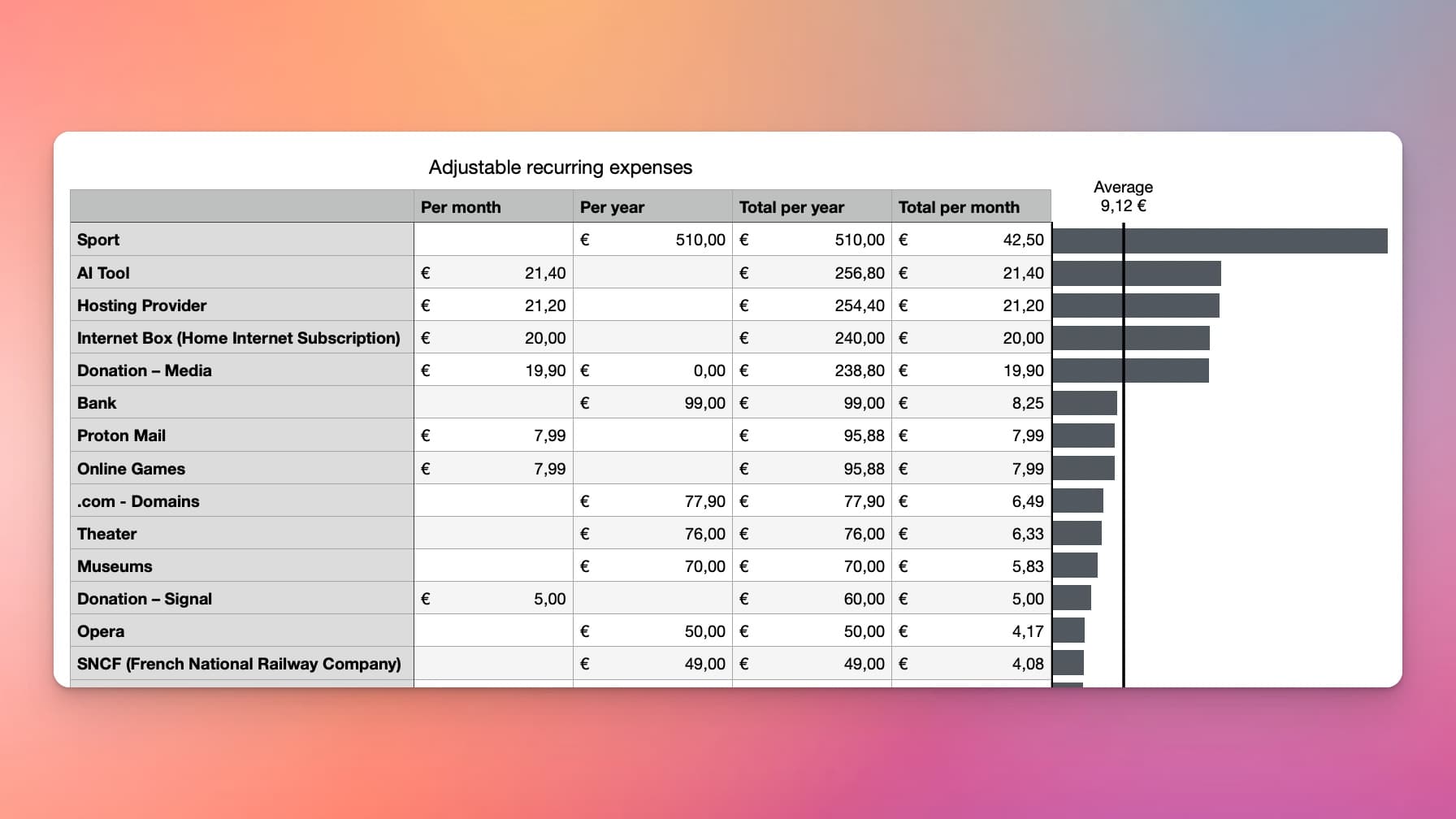
I've been practicing fencing for years and I love it. But my annual membership (€510) is still compressible: I could decide not to renew it if I needed to tighten my budget.
In my Excel sheet, I simply note:
- Name: Fencing
- Annual cost: €510
- Monthly equivalent (automatic): €42.50
This helps me see the real weight of my subscriptions.
Annual subscriptions: a psychological trap 😈
- Example: my bank → €99/year = €8.25/month.
👉 Paid in one go, it's easy to forget. But when broken down monthly, you realize how much it really costs compared to your other subscriptions.
The “one-off” expenses that aren't
Some “one-time” purchases actually repeat every year.
- 🎫 SNCF Youth Card: €49/year = €4.08/month
- 🎟️ FNAC loyalty card: €4.99/year = €0.42/month
Adding these small amounts up gives a much clearer picture of your expenses. To go even further, you might even consider that if you change your phone every two years, the monthly cost of that renewal is also a recurring expense.
📊 My results
By listing all my compressible expenses, I reached about €191/month.
😮 That feels like a lot!
But according to an Ipsos survey (2021), French households already had 10 monthly subscriptions on average. Since then, both the number and the cost of subscriptions have increased.
👉 That's why it's crucial to track your subscriptions regularly—to avoid forgotten renewals.
How I saved money
By writing everything down, I realized some subscriptions weren't worth it. I canceled:
- Le Monde (€12.99/month)
- Disney+ (€9.99/month)
- Brawl Stars (€11.99/month)
- ChatGPT (€22/month)
💥 Result: €57/month saved = €680/year 🎉
🔍 How to identify them all
- Monthly expenses: just review your latest bank statement.
- Annual expenses: ask yourself “What do I pay for every year, even if I consider it one-off?”.
Also, make it a habit to note any new recurring expense as soon as you discover it.
Incompressible expenses
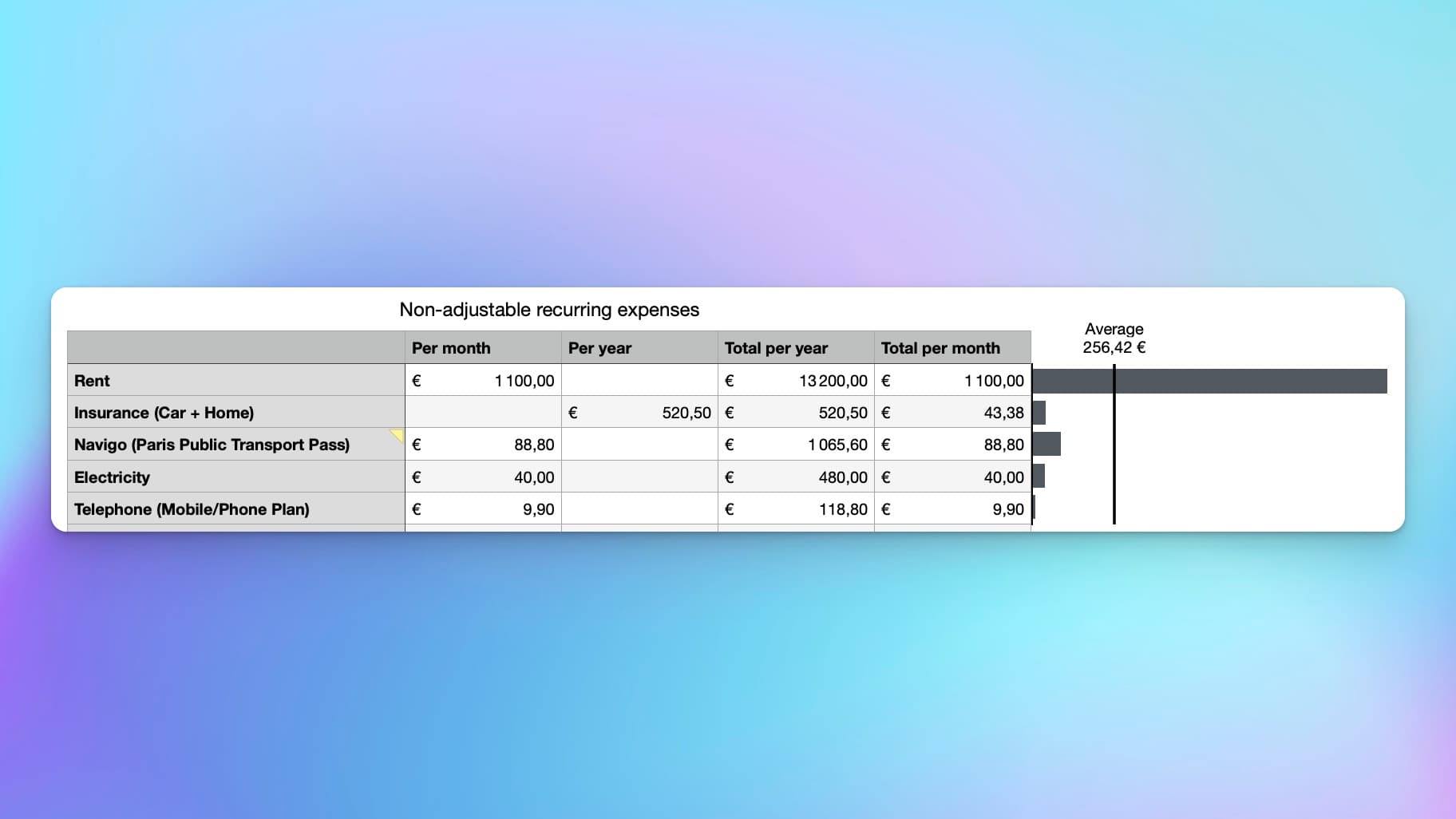
Alongside compressible ones, list your incompressible expenses (the ones you can't really cut):
- Rent 🏡
- Insurance (home, car)
- Transport 🚇
- Mobile subscriptions 📱
- Electricity ⚡
You can't remove them, but it's important to keep them visible.
💰 Calculate your "disposable income"
Once you've built both tables (compressible + incompressible), you can calculate your disposable income:
- Take your gross annual salary.
- Convert it to net (for example with brut-en-net.fr).
- Subtract your incompressible expenses.
👉 What's left is the money you really have to live, save, or invest.
✅ Your action plan
Here's a quick roadmap:
- List your compressible expenses 📝
- Build your incompressible expense table 🏷️
- Calculate your disposable income 💰
- Spot subscriptions you don't need ✂️
- Save at least €50/month → €600/year 🎯
🚀 Conclusion
This simple table is already a powerful starting point to regain control of your budget.
And remember: saving €50/month is no small thing.
👉 After a year, that's nearly 42% of a minimum wage! 💵
Did you find this article useful? Feel free to share it and tell me how much you managed to save! contact@hellofabien.com